
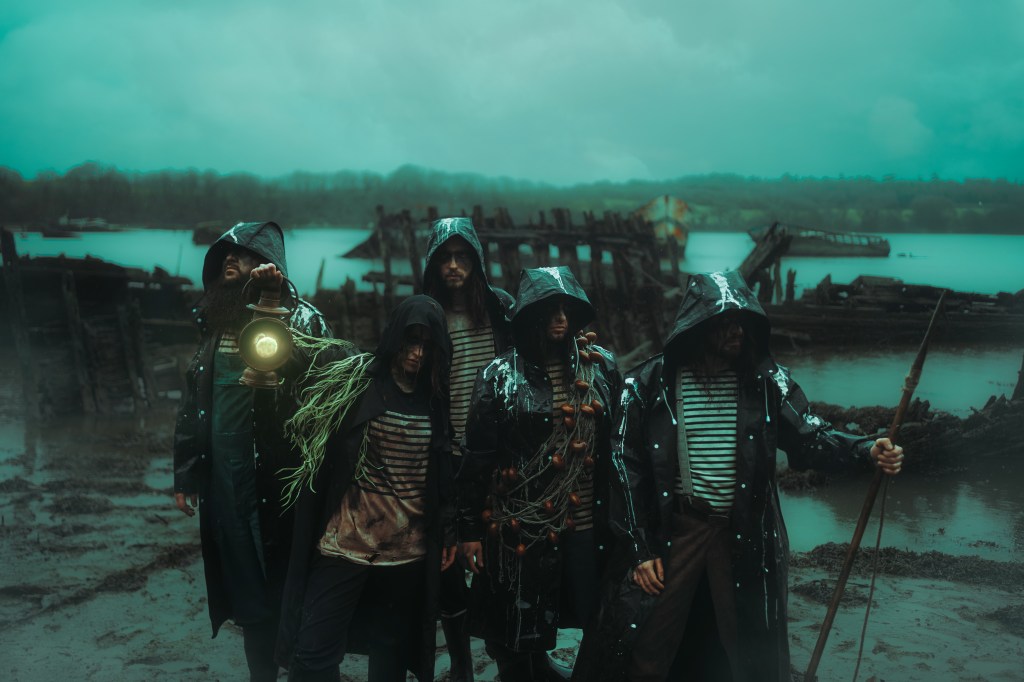
Photo by: @ Faallaway
Crabe: I was born in Brest, which is in Brittany, the western region of France, which is renowned for coastal and seaside landscapes. So when I came to Paris, I was feeling a bit homesick, so I decided I wanted to do something that would remind me of home. And, you know, being in Black Metal, you push it to the extreme. From just talking about home, you go to talking about being on boats and fishing and all that good stuff. Then it becomes a storm with big sea creatures or whatnot, and legends and all that kind of stuff. We kind of pushed it a little further than it was initially meant to be, but that’s the beauty of it all, I guess.
Was the idea for the band yours? How did the other members get involved?
Crabe: No, initially it was just me, because I was by myself, and I knew no one in Paris. And that was also one of the ideas – to meet some people who enjoy the same type of music. So I wrote a few songs and then posted them online and tried to find people that would be interested in playing and making it a live project. And then eventually everybody came around. Zephyr, who plays rhythm guitar was the first, and is the oldest one in the band. And then came Vikser, who plays drums, Adsa who is the singer and GreyGaast who’s the little one, the baby in the band, who arrived last. And I guess afterwards, it kind of became a theme that everyone kind of made their own and it wasn’t really a personal project anymore – it’s really a five-piece band. I think, it makes it more interesting that everyone’s ideas are brought to the table.
Were the marine and ocean ideas only yours, while the others just enjoyed the Metal genre?
GreyGaast: We all resonated with it, I think, it’s a universal concept, really. And it’s quite easy to to be immersed in it and get the imagination going. So, I guess, the whole five-piece band could contribute, you know, riffs, lyrics that resonate with that theme. There was a very solid foundation.
Crabe: It started from an idea and then, it’s like, the work that we all put in together which created what it is today. But we didn’t have any sonography because we hadn’t played live, we didn’t really have any lyrics either, because I wasn’t, and I still am not really a lyricist. I had some ideas, titles and emotions that were linked to the first songs and then everyone kind of came along and we developed that together.
Do you think it’s easier to rehearse and play now than at the start?
GreyGaast: Easier now…
Crabe: …because we don’t really have time to rehearse (laughing). We rehearse maybe once before like a particularly big show, right? But we have played so many shows in the last few months that if it’s like once every month, we kind of practice ourselves, each on their own, and then we get to the show, and we kind of expect everyone to have done the work. Usually, it goes quite well. So far, it hasn’t harmed us too much, but we do that so that we can advance on other things in the meanwhile, right? Because people also expect some new music to come out at some point.
How did you choose the members, or did they find you?
Crabe: There’s a website here in France that I used just to put an announcement on, saying: “Hey, we are starting a new project. Just ask me, and I’ll send you some MP3 tracks that I recorded with garage band on the bare minimum.” And eventually some people answered. So I got started like that. And we replaced a few band members: the first drummer had to leave Paris, so we replaced him. But each instrument changed once. And then, I guess, we found Adsa, who was the last member who came via the Internet announcement. And I guess, GreyGaast is her best friend. So she was like, if you bring me into the band, I’ve got a nice plan for you to have a bass player as well.
So now we had a complete lineup. We didn’t really ask for much at first from the band members. We didn’t expect anyone to be, like, a brilliant technical player. We kind of just went with people that we felt good with. And I think also, from the very start, I was very lucky because we often joke about the fact that for example GreyGaast who plays bass, is probably the best guitar player in the band. And he works a lot and so does Vikser, they got very good or a lot better than they were two years ago whereas us guitar players – we didn’t really improve all that much. And Adsa hadn’t ever sung screaming vocals before she got into the band. She was starting. And, you know, four months later, we did the recording of the first EP and she got a lot of praise for that, so I guess she was a bit of a natural there.
GreyGaast, how did you join the band? What attracted you to it?
GreyGaast: Adsa brought me into the band when she arrived. And the sound was way more melodic than what you typically think of, like classical black metal. And that’s what I liked musically.
Your latest album contains the themes of the human struggle against the forces of nature. Can you elaborate on the meaning behind the album?
Crabe: The first EP had more to do with the beauty of Nature, and the godly aspect of the ocean. Very Black Metal in a way. Like nature as the front enrolment of the music. There probably have been a lot of people exploring, or a lot of bands exploring that theme, because it’s very common, because it’s very beautiful. So everyone wants to depict nature in a beautiful way, in a very romanticised way. And we decided we’d go along another path for the debut album, which was bringing it back to the people living their lives next to the sea, or on the sea. And that made us able to capture a lot more emotions, a lot more real images that speak to people.
Because it’s outside of the time spectrum, right? As long asyou’re human, it can be 2000 years ago. It can be 100 years ago. It can be nowadays. Everyone can have those fears and struggles and pains and I guess it made the album, or the themes, perhaps more interesting for us. I think it’s probably something that we’re going to keep on exploring in the future, because when you start from a human perspective you can go in a lot of directions rather than when you start from the ocean.
Because when you take the ocean you can describe it in so many ways, and then you can describe what’s above, what’s beyond it, what’s beneath it. But that’s about it. And we definitely didn’t want to do some, some kind of love craft in project. We want to visit themes that are outside of that. So that’s got more to do with harbours and on boats, not under the sea, because it’s been done, and it’s been done well by a lot of bands. So we’d rather stick to something different.
I know that you said that your music is not aimed at anyone. But are there any emotions or messages that you aim to communicate through the lyrics?
Crabe: That would be a better question for Adsa if she was here, because I know that she writes most of them, and I can definitely say they sound more personal when she’s the one writing them. GreyGaast, correct me if I’m wrong. But it sounds more like her handing out a piece of herself when she writes the lyrics herself, than it is when I do or when the Vikser does it. We’re more into storytelling or a visual representations of a certain picture, a certain painting of something that we want to help others visualise.
It sounds like hers are more troubled, more personal, more stretched in emotions and such things. That’s why I think she makes it that much more interesting. Like our music wouldn’t be half as good if she wasn’t there for sure. And I very much admire the way she writes. I have no clue how she does it but I know that if you met her – she’s a very extreme living type of person. She has her ups and downs, but the music and the way she writes her lyrics reflects the type of personality she has.
You mentioned that Adsa is an extreme living type of person?
Crabe: I wouldn’t know how to say that, but I hope she doesn’t mind me saying that. She’s kind of chaotic in every sort of aspect of me knowing her, and it’s a very man type of environment. So we’re kind of always wanting to protect her. I don’t know if that’s true, but at least she doesn’t really need our protection. She’s kind of the most Black Metal individual from the band, for sure. She’s kind of different, I suppose. I don’t think any of us would be capable of reproducing the type of lyrics that she’s writing, because we don’t have the same character and personality as she does. It’s very much when you hear her singing, it’s very much her, even though the character on stage is different. The interpretation is very much herself. I couldn’t explain it more accurately because it’s a very specific topic, but it’s certainly interesting to think about for sure.
What was your favourite moment with the band so far?
Crabe: I feel like there have been lots of moments, like, lots of shows, where you turn around and you gather up after the show, and you feel like ‘fuck me, that was like a great show’. But I guess maybe the first time we went to Germany and we were playing with Kanonenfieber and Batushka, we felt like probably no one would come and see the show. And after a while, the first show, it ended up being like a really goodshow and we kind of understood that the language barriers didn’t really matter, people could enjoy. And then I thought, like, how did we get here? Like playing in Germany in front of hundreds of people and just loving it? It was so cool for me. That was one of the big things we played in Hamburg, and I have some family there, and seeing, like, some family members coming over to see a show, I don’t know, 2000 km away from where you live – was pretty awesome.
GreyGaast: So it’s difficult to pinpoint, like, one specific favourite moment. There are loads of little snippets of really cool events, just hanging out with the band and the other bands we play with. And also speaking with fans. And loads of occasions where we meet like stupidly cool and crazy people, that we weren’t expecting. So that’s always cool.
Crabe: When you get a day off during touring, and you can just have a day with your friends but far away, it’s pretty nice. It feels like an adult holiday, I guess.
Who is Houle music for?
GreyGaast: Anyone who wants to get immersed into whatever it is.
Crabe: I know that we’ve been told that it’s an approachable type of Black Metal. Like it’s somewhere at the crossroads with more heavy metal aspects. So, for sure it’s maybe a more approachable type of music. Now that’s also linked to the fact that when I hear the albums that I listen to, I sometimes don’t understand how the guys, women, or whoever is playing, come up with the structures of their music, because it’s so complex to me. The way I write stuff is basically, you know, riff one, riff two or three, and then some sort of easy structure, because that’s how I can visualise it. So maybe it’s also perhaps a little bit easier to get into because it’s maybe an easier structure. The riffs are sometimes sort of complex, but at least it makes it stick to your head maybe a little more.
GreyGaast: I think you’ve really managed to write a good song when you can do something complicated and make it seem simple. And I think we complement each other quite well – there’s a certain beauty in doing something very simple and direct and very, you know, I don’t want to say effective, but monolithic. And you do that really well. I’m sort of like a loose cannon, and go all over the place. And I think we found a balance in the condition.
Crabe: But when it comes to ‘Who is that aimed at?’, probably, like, you know, die hard Black Metal fans like true Black Metal. When they want something maybe a little more laid back, more melodic but without going into mainstream or heavy metal or mainstream metal, it would be perhaps like compromise, something more laid back for the really brutalblack metal listeners.
And then for some people that perhaps are looking for some more extreme stuff when jumping from heavy metal, that could work out perhaps. It’s one thing that GreyGaast was saying earlier, and that does make sense, that the ocean is kind of something universal. So the fact that it’s universal, it’ll speak to everybody. But when you think musically, it’s something that is often overlooked. But then the theme itself, it kind of reaches everybody. It speaks to everyone.
Now we get messages from fans, all over the place telling us that ‘I was in the marines’ or ‘I was a fisherman’, or ‘I was a captain’, and ‘Your music reminds me of my years when I did that’. So for people who have this same nostalgia of the ocean, that maybe I did, what we’re writing kind of speaks to them as well. Not that people who have like thalassophobia, they’ll probably not want to listen to it. But maybe that’s the answer. I don’t know. To be fair, it’s true that we really haven’t thought of that before.
 undercoremag.com